
A word about Vladimir Ktoyanț, many times champion of Moldova in table tennis
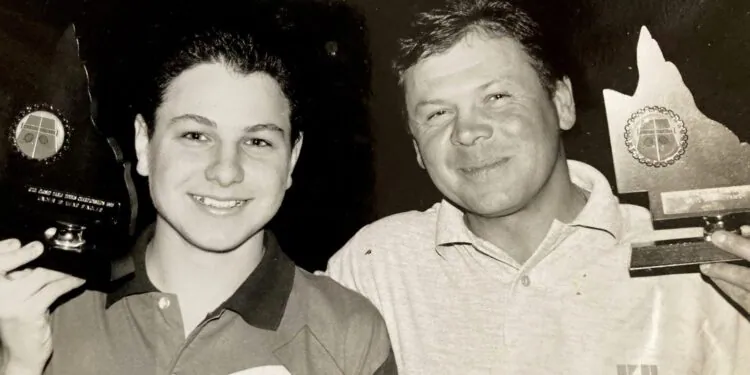
It is almost a year since your humble servant sharpened a pen, and not one piece about our beloved sport — table tennis — has appeared over his signature. There was a reason for that, and, we would stress, a weighty one. As we can see, the “corona” that has raged since the spring of last year shows no sign of retreating. Having regrouped, the tamers of the nimble plastic ball will remind us of themselves again with new and gripping competitions, the nearest of which begin this spring, in the middle of March. There is a little over a month until the first starts, but preparation for these official competitions is already in full swing in every school in the country.
While our esteemed players polish their craft, this is a good moment to talk about a many-times champion of our republic, Master of Sport of the USSR Vladimir Ktoyanț, who has lived in far-off Australia since 1992. We have never forgotten this remarkable master of table tennis, who shone in the 1970s and 1980s, any more than we have forgotten our other respected veterans. Quite recently the head of the country's federation, Vladimir Semipeadnîi, was approached by someone passing on greetings from Ktoyanț and asking him to get in touch. Vladimir Olegovici telephoned the well-known player in Australia at once.
So there is reason once again to remind our readers of a master of the little racket like Ktoyanț. Incidentally, in the autumn of 2000 this remarkable player came to Chisinau on personal business. And it so happened that at the very same time Chisinau was hosting the open international table tennis tournament for the prizes of SA “Franzeluța”, in which, to our great delight, our esteemed guest took part. The visit produced an interview in which Vladimir spoke about his life in Australia and about the long-awaited reunion with his Moldovan friends.
At the end of the 1960s the hero of today's account, Vladimir Ktoyanț, also came into Moldovan table tennis. He did not, it is true, begin his sporting career with table tennis. As Vladimir admitted, at first he was drawn to other sports. He loved football. He had a name as a decent goalkeeper. He held a swimming grade. In the fifth form he was a candidate master of sport in acrobatics. At School No. 55 in the capital his classmate was Vladimir, son of the celebrated Moldovan player Grigori Lazarevici Grinberg, and by then himself a candidate master of sport — in table tennis. It was largely thanks to Vladimir Grinberg that Ktoyanțgave himself to the new game, towards which, as he has admitted more than once, he feels something special.
At first he trained in the sports hall of the Officers' House, where the coach Alexandr Kunichenko worked with beginners and the most experienced player in his group was the candidate master Ivan Kumanov. Even then young Vova astonished everyone with his devotion to his chosen sport, as one curious episode shows. It was winter, in heavy snow. Many decided there would be no training in such weather and did not turn up. Vladimir thought otherwise: showing enviable resourcefulness, and to his coach's great surprise, he made it safely to the Officers' House on skis. It was then that Ktoyanț's mentor spoke his prophetic words: “This boy will certainly make a good player!”.
Then training continued in Botanica, at the newly opened Trudovye Rezervy sports complex. Here, under Iosif Moscovici, Boris Goldenberg and Eduard Martynenko, trained the whole flower of Moldovan table tennis of the day — Alexandru Radelis, Boris Volnyansky, Veaceslav Balan, Fred Kraizel, Natalia Remezova, Irina Badikova, Yuri and Mila Perelmuter and other players well known in the republic. Vladimir was taken into the group of Boris Mironovici Goldenberg. I trained more at home than in the hall, Vladimir Ktoyanț recalled. I badly wanted to beat the older and more experienced Radelis and Volnyansky, who at first gave me 20 points of a head start — and won.
Thanks to his persistence and his character, within about three years there was no difference in skill between us at all. He liked to train at home against the wall. He invented all sorts of exercises. He worked through a range of services. My training aids were most often the sofa and the cushions. He gave attention to tactics as well. In his best years he rarely lost. That happened only when he was out of form. He played at USSR championships for his republic, reliably bringing it important points, Ktoyanț concluded.
To his credit are wins over the well-known leaders of Soviet table tennis Igor Solopov and Valeri Shevchenko. He also played another experienced master — the 1986 USSR champion Igor Podnosov — but lost to him after a hard fight. He beat the strong Odesa players Stadnichenko, Yerentyuk and Saprykin. He got the better of the well-known Russian player Yuri Volochkov, USSR champion in 1983 in the pairs with Ivan Minkevich — and, incidentally, the father of the society figure Anastasia Volochkova. In those years Yuri often took little Nastya along to various competitions. And when Ktoyanțadvised him to put Anastasia into table tennis, Volochkov replied that she did not like table tennis; she liked ballet.
Volodya was bound in friendship to the well-known Nistru footballers Georgi Teglyatsov, Valeri Pavlov, Yuri Khlopotnov, Vladimir Safronenkoand other stars of that beloved team. Teglyatsovoften came to important competitions to support his friend. Here is how Moldavskie Vedomosti put it in 2009: “From his school days Teglyatsovwas a friend of the many-times champion of Moldova Vladimir Ktoyanț. He often went to their training sessions and to competitions held at Trudovye Rezervy. He knew the whole elite of our table tennis. He admired his friend Vova Ktoyanț. He valued the talent of Alexandru Radelis, Boris Volnyansky, Fred Kraizel, Lyudmila Perelmuter, Lidia Grinberg, Nina Polkanova and many other of the strongest of that generation of masters of the little racket. He remembered the play of Asta Gidraitite of Lithuania and the Azerbaijani player Nazim Rshtuni”.
Ktoyanț left a notable mark as a coach too, bringing on a good number of strong and accomplished players. Experienced players such as Sergei Tihonov, Tatiana Iaroș (Lebediuc), Natalia Petcova and others were well schooled by him. One of his finest pupils, Tatiana Iaroș (Lebediuc), speaks warmly of her coach: “Training with Ktoyanț was always lively and interesting. He was forever inventing some new exercise for us, which we were happy to work through. He gave a great deal of attention to the tactics of the game”.
Australia. He came here for good in 1992. Australia is a fine place if you have work. Any labour is valued here. Naturally, I wanted to prove myself in table tennis as well, Vladimir Ktoyanț said in the interview. The resort city of the Gold Coast, where our former compatriot lives, is the second largest by population (600,000) in the state of Queensland and the sixth largest in the country. Washed by the Coral Sea, the Gold Coast is one of Australia's largest tourist centres. It is also known that the first European to visit the territory of the present-day Gold Coast, in 1770, is considered to be the English navigator James Cook.
In Australia Vladimir twice became champion of his state of Queensland. He also took second place. In the 1995 team championship they had a good chance of becoming national champions. On the way to the final Ktoyanț's team won every tie. Our countryman won all of his own matches. Ahead lay the final, for which the club's management, for some reason, did not enter him. And so a real chance to become champions of Australia was lost. Vladimir was, of course, deeply upset.
Our former compatriot also brought on a very strong player, Martin Rogers, of whom he was very proud. Martin trained under Ktoyanț for about three years, and it was precisely under Vladimir Ktoyanț that he grew into a leading player in Australia. Playing in the same team as his coach Ktoyanț, they became champions of their state of Queensland. Both his daughters — Anita and Akulina — were successful athletes too, in rhythmic gymnastics. Anita Ktoyanț performed the more brightly at the top forums of rhythmic gymnastics; one of her rivals was the well-known Russian gymnast Alina Kabaeva. At home Anita was first, and in the world fifteenth.
The long conversations with Ktoyanț, a veteran of Moldovan table tennis, left a pleasant impression. In them he showed himself an excellent storyteller as well. As our subject admitted, he still follows Moldovan table tennis and wishes it great achievements. He speaks respectfully of his rivals. He remembers all their strengths and weaknesses. He speaks warmly of the player Vladimir Ceban. He is a very talented, technical player. Beating Cebanwas no simple matter. He is a real fighter, who also played well at the all-Union competitions of the Trudovye Rezervy central council, where he took a high second place.
Recalling Alexandru Radelis, he noted more than his table tennis successes. Alexandruplayed football decently. His coordination and his masterly handling of a football were striking. He could have achieved more in table tennis. But by then the new 2.5 mm rubbers were beginning to appear, and he was used to playing with 1 mm. He could not live through those changes, and stopped feeling the ball. Whereas for me, says Ktoyanț, those same changes were nothing but a benefit.
A coach, in Vladimir Ktoyanț's view, does not have to be a strong player. He has to be able to keep the ball on the table well. He needs a head on his shoulders and organisational ability. He has to teach his charges technique and tactics. He has to be able to find sponsors and to understand marketing. Every player is material that has to be brought out. He spoke about his friends too. About Boris Volnyansky, who has left us, an extraordinarily talented player; about his lifelong friend Valeri Grigoriev, about Anatolie Bivol and Alexandr Goldvarg. He is in constant touch with Alexandr, who lives in Israel. All of them are thoroughly decent and dependable friends. Iosif Moscovici he describes in a single word — supercoach. Taking the opportunity, he asked us to pass on his warmest greetings and best wishes to them. Good wishes to Yuri Perelmuter, Tatiana Stolyar, Alexandr Goldvarg, Vladimir Semipeadnîi, Valeri Grigoriev, Valeri Grosul and many others. And, as Vladimir Ktoyanț asked, warm greetings to all of his pupils.
Our former compatriot also speaks flatteringly of the present president of Moldova's federation, Vladimir Semipeadnîi, against whom he often competed at city and republican events. Back in 1983 the two of them were the favourites for the individual championship of Moldova. That match ended in a win for Semipeadnîi, 2:1. It was Vladimir Olegovici's first great victory in the national championships. In all he holds nine such titles. Naturally, Vladimir Ktoyanț is glad for Vladimir Semipeadnîi, whose pupil Andrei Puțuntică stands very high in the world ranking today. Andrei's 245th place is an incredibly high position for a player from Moldova, says Ktoyanț. I take my hat off to Vladimir Semipeadnîi, who has managed to bring on such a remarkable master, with medals from world and European junior championships to his name. In our day we badly lacked a player as strong as Puțuntică.
Such is our short excursion into the recent past of Moldovan table tennis. Memory holds tightly to all the best that this sport has always been famous for in the hands of highly professional masters, whose names — Vladimir Ktoyanț's among them — are always on our lips.
P.S. On 14 February, St Valentine's Day, Vladimir Ktoyanț turned 65. We wish the many-times champion of Moldova good health and long life!
Ivan Capsamun